
Interventional Care

We notice that you are visiting us from . This site only services US-based visitors. Would you like to visit the site that is appropriate for your location?
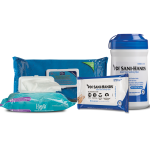
How long should I apply Sani-Hands® Instant Hand Sanitizing Wipes to the hands?
A contact time of 15 seconds provides a 99.99% reduction.
What is the expiration date on Sani-Hands® Instant Hand Sanitizing Wipes?
Sani-Hands wipes have a 24 month expiration date from the date of finished product manufacturing.
Does PDI have clinical personnel on staff to answer any clinical questions?
Yes. PDI has a team of Clinical Science Liaisons (CSLs) on staff to help answer questions as well as help facilities identify best practices for improving outcomes and reduce the incidence of Healthcare-associated Infections. CSLs are also available to deliver clinical education, perform clinical assessments, and provide consultation on various infection prevention topics.
What Personal Protective Equipment is required when using Easy Screen® Cleaning Wipes?
No personal protective equipment is required; however, we recommend that you follow your facility’s protocol on use of gloves and other personal protective equipment in clinical settings.
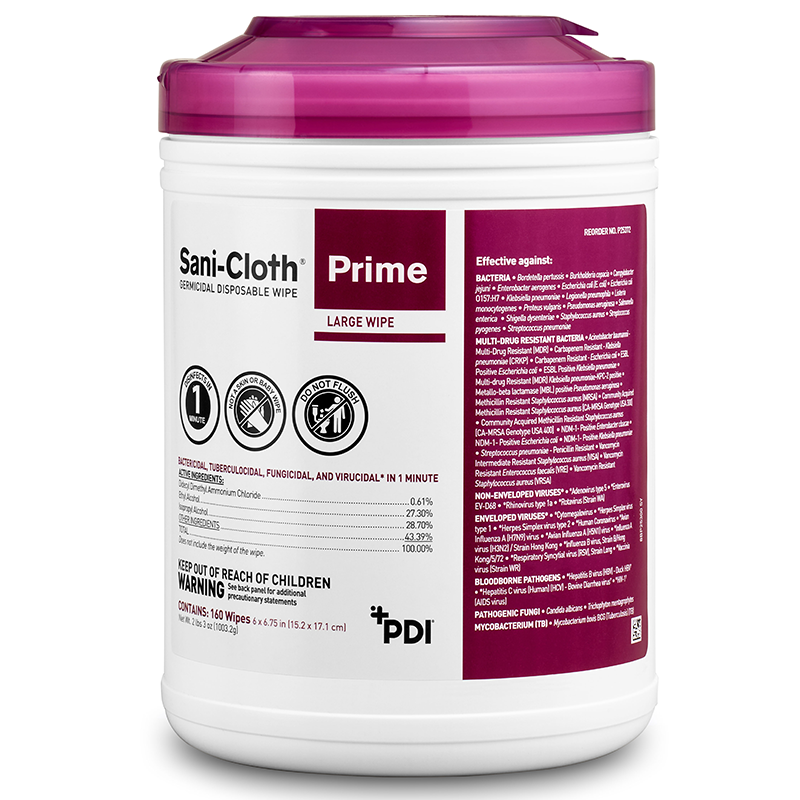
What is contact time and what happens if the surface dries before the stated contact time on a Sani-Cloth® and Sani-Prime®product label?
The contact time listed on the product label is the total amount of time that it takes to inactivate ALL of the microorganisms listed on the product label. This time is typically referred to in minutes, and should be communicated to staff members that are utilizing the disinfectant. In certain geographies and also in settings where temperature, relative humidity, and air changes may vary, it is possible that the surface may not remain visibly wet for the designated contact time. Current EPA guidance requires that the treated environmental surface or equipment remains wet for the contact time stated on product label. Additional wipes may be needed in order to comply with the EPA guidance, however the overall contact time does not change.
While the EPA requires the treated environmental surfaces to remain wet for the stated contact time, leading researchers in infection prevention offer an alternate view. In a commentary published in Infection Control and Hospital Epidemiology (March 2018, vol. 39, no. 3, pp 229-331), Dr. W.A. Rutala and Dr. D. J. Weber suggest that contact time and treatment time are mutually exclusive. They suggest that treatment time, irrelevant of wet time, should be followed by healthcare workers for wipes and sprays (except bleach products.) PDI will continue to monitor the science closely and provide their customers with the latest information as federal law permits.
Where can I find the expiration date for PDI’s Germicidal Wipes and Sprays?
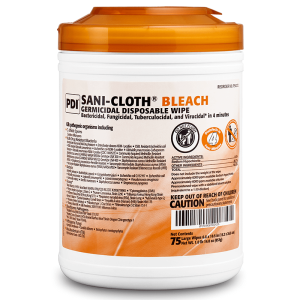
The expiration date is stamped directly on the product. Sani-24® Spray, Sani-Prime® Spray, Sani-Cloth® AF3, Super Sani-Cloth®, Sani-Cloth® Plus, and Sani-Cloth® HB products have a shelf life of 24 months from the date of manufacture. Sani-Cloth® Prime Wipes, Sani-HyPerCide® Spray, and Wipes have a shelf life of 12 months. And, Sani-Cloth® Bleach wipes have a shelf life of 11 months from date of manufacture.
Please NOTE: Product can be used until the expiration date, even after being opened.
Do PDI Germicidal Disposable Wipes and Germicidal Sprays contain any ingredient listed as carcinogenic?
PDI disinfectants DO NOT contain any ingredients listed as a carcinogenic by the National Toxicology Program (NTP), American Conference of Governmental Industrial Hygienists (ACGIH), and Occupational Safety and Health Administration (OSHA). To register any disinfectant product with the US Environmental Protection Agency (EPA), the manufacturer is required to provide the EPA with the product’s manufacturing process, active and inactive ingredients, efficacy, chemistry, toxicity, and information about relevant impurities. The EPA conducts a thorough review of these materials and product’s ingredients. The agency would not register any product if it contained carcinogens without requiring relevant label warnings (40 CFR 156.10(g)(7)). As such, Sani-Cloth® Wipes and Sani-Prime™ Spray do not contain carcinogenic label warnings.
Does NFPA 30 apply to PDI disinfectants (Germicidal wipes and sprays)?
NFPA 30 applies to the storage of flammable and combustible liquids. PDI products, including Sani-HyPerCide® wipes and spray, Sani-24® spray, Sani-Cloth® Prime wipes, Super Sani-Cloth wipes, and Sani-Cloth Plus cloth, as well as Easy Screen® Cleaning Wipe, are exempt from the requirements of NFPA 30. This is because the scope of NFPA 30 (Section 1.1) states that it applies to the storage, handling, and use of flammable and combustible liquids. Even though our products contain liquids that have been classified as flammable on the SDS, the wipes themselves are not classified as liquid products. Rather, they are wipes impregnated with flammable liquids, even though there may be a small amount of free liquid in the bottom of the canister. According to the EPA, wipes are classified as a mixture product containing solids and liquids. The NFPA has also confirmed that wipes are not considered to be liquid for the purposes of NFPA 30. In addition, NFPA Section 9.1.4(4) states that it does not apply to “medicines, foodstuffs, cosmetics and other consumer products that contain more than 50 percent by volume of water-miscible liquids, with the remainder of the solution not being flammable where packaged in individual containers that do not exceed 5L (1.3 gallons) capacity.” For the above reasons, NFPA 30 does not apply to PDI products. Please verify these storage requirements against your insurance carrier requirements since they may be more stringent than NFPA 30.
Do Sani-Cloth®, Sani-Prime® and Easy Screen® products carry California Proposition 65 Warning?
Sani-Cloth, Sani-Prime and Easy Screen products DO NOT carry California Proposition 65 Warning. Proposition 65, officially known as the Safe Drinking Water and Toxic Enforcement Act of 1986, requires the state to maintain and update a list of chemicals known to the state to cause cancer or reproductive toxicity.
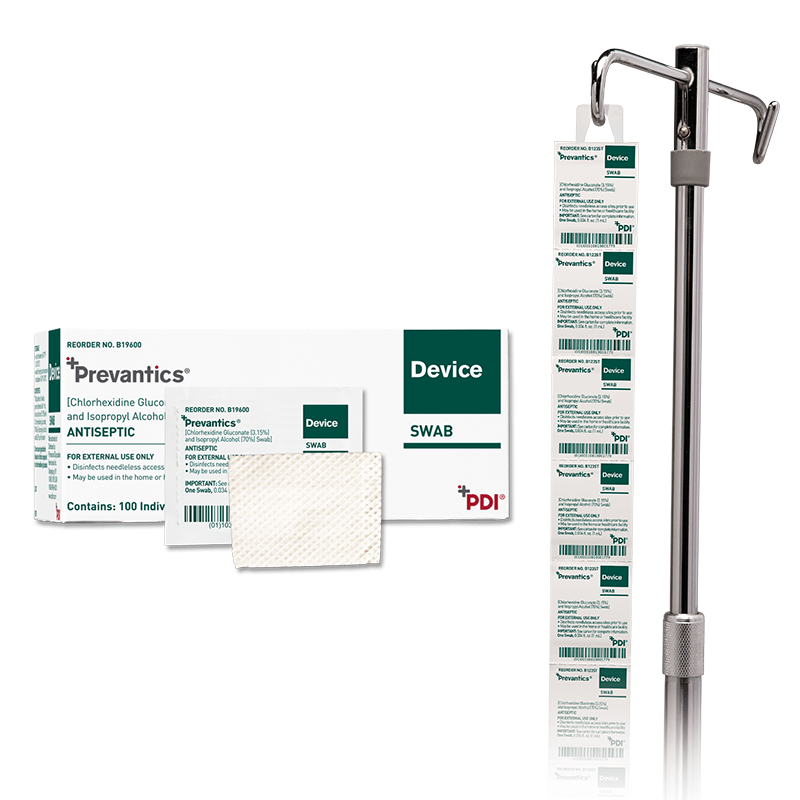
Why are Prevantics® Skin Antiseptics applied using back and forth strokes?
The back and forth strokes provide friction which allows for deeper penetration of the antiseptic into the cracks and fissures of the skin in the epidermis.
Can PDI Germicidal Wipes and Sprays ship by air transportation?
Most Sani-Cloth® brand products can be shipped via air transportation. However, Sani-24® and Sani-Prime sprays, as well as Sani-Cloth Prime wipes, Super Sani-Cloth wipes and Sani-Cloth Plus wipes cannot be shipped by air due to shipping regulations. These products are shipped via ground transportation only.
What evidence-based clinical guidelines support the use of the Prevantics® Device Swab for disinfection of needleless access sites prior to use?
The following evidence-based clinical guidelines support the use of Chlorhexidine Gluconate/Alcohol for disinfection of needleless access sites prior to use:
1. Guidelines for the Prevention of Intravascular Catheter-Related Infections, US Centers for Disease Control and Prevention (CDC)
2. Standards of Practice, Infusion Nurses Society (INS)
3. Strategies to Prevent Central-Line Associated Bloodstream Infections in Acute Care Hospitals, Society for Healthcare Epidemiology of America (SHEA)
4. National Patient Safety Goals, The Joint Commission
5. Clinical Practice Guidelines for Diagnosis and Management of Intravascular Catheter-Related Infection, Infectious Disease Society of America (IDSA)
6. Elimination Guide to Infections in Hemodialysis Settings, Association for Professionals in Infection Control and Epidemiology (APIC)